Top 3 Myths About Marriage

Marriage is one of the most significant and life-changing milestones in a person’s life. However, it’s also one of the most misunderstood institutions in the world. Over the years, many myths have emerged about marriage that have shaped people’s perceptions of the institution. In this post, we’ll explore the top three myths about marriage.

Myth #1: Marriage is Easy

One of the most pervasive myths about marriage is that it’s easy or “should” be easy. Many people believe that once they find the right person, they’ll live happily ever after. However, the truth is that marriage takes work. It requires effort, compromise, and sacrifice from both partners.

Marriage is not just about finding the right person; it’s about building a life together. It involves creating a strong foundation of trust, respect, and communication that will allow the relationship to thrive. This requires ongoing effort and dedication from both partners.

Unfortunately, the myth that marriage is easy can lead to unrealistic expectations and disappointment. Many couples give up on their marriage when they encounter challenges because they believe that if it’s meant to be, it will be easy. In reality, every relationship has its ups and downs, and it’s the couples who are willing and able to put in the work that will succeed.

Myth #2: Marriage Will Solve All Your Problems

Another common myth about marriage is that it will solve all your problems. Many people believe that once they get married, all their problems will disappear. They’ll have someone to share their life with, and everything will be perfect.

However, the truth is that marriage will not solve all your problems. In fact, it can create new ones. When two people come together in marriage, they bring their individual strengths and weaknesses. While these differences can complement each other, they can also cause conflict.

Marriage is not a magic solution to life’s problems. It requires couples to work together to overcome challenges and find solutions. This means that couples must be willing to face their problems head-on and work together to find solutions.

Myth #3: Marriage Will Complete Me

The third myth about marriage is that it will complete me. Many people believe that finding the right person will make them whole and complete. However, the truth is that no one can complete you but yourself.

Marriage is not about finding someone to fill a void or make you feel complete. It’s about finding a partner who complements you and supports you in your personal growth. Both partners should be able to maintain their individuality while building a life together.

Believing that marriage will complete you can put undue pressure on your partner and the relationship. It can also lead to disappointment and disillusionment when the reality of marriage doesn’t meet your expectations.

Marriage is a complex institution that requires effort, dedication, and cooperation from both partners. There are many myths about marriage that can lead to unrealistic expectations and disappointment. By understanding the realities of marriage and being willing to work together, couples can build strong and healthy relationships that stand the test of time.

5 Fundamentals of Healthy Relationships and Why They’re Challenging

Maintaining a healthy loving relationship is vital for personal well-being, happiness, and fulfillment. It requires effort, patience, understanding, and consistent work. Many of us already know about some of the key elements that can help in maintaining a healthy relationship. Things like good communication, compromise, trust, forgiveness, and being true to yourself and your values all play pivotal roles. However, there’s often more to it and even these 5 fundamental elements can be challenging to put into practice at times. Here are some reasons why.

Good communication takes certain skills that not everyone has learned to practice effectively. It’s not just about using words and it’s not always easy. It requires honesty and being able to express your thoughts, feelings, and needs in a clear and respectful manner. It also means being able to listen actively to your partner and trying to understand their perspective. All of this can get very complicated when emotions, past history, resentments, and trauma come flooding in.

Compromise is another element that’s often discussed when trying to maintain a healthy relationship. And while being able to find a middle ground and make mutual decisions that benefit both partners sounds reasonable and good on paper, it often poses difficulties. The very definition of compromise is a mutual “concession” or accepting standards that are “lower than desired.” And who wants that? No one wants to lose or feel like something important is taken from them. If we feel that the scales are unbalanced and over time one partner is compromising more or more often, this can build resentment and lead to contempt which is a relationship killer. Learning how to cooperate and re-frame unhelpful narratives to more of a “win/win,” requires patience and maturity that only happens with practice over time.

Trust is crucial for any healthy relationship, but what happens when trust has been broken or if past history has made it feel unsafe to trust or even feel comfortable knowing how to trust? It takes time to build trust and it requires consistency, honesty, and transparency. It also takes self-work to help heal past traumas, set healthy boundaries as well as keep promises, and be reliable, dependable, and worthy of trust.

Forgiveness is also an important aspect of a healthy relationship. It’s normal to make mistakes and experience hurt and misunderstandings, but it’s essential to be able to forgive and give each other a chance for restoration. Forgiveness is not about forgetting, but it’s about granting grace, moving forward, and learning from past mistakes. It is also a learned process that involves knowing how to ask for, grant, and accept forgiveness in a healing way that is not superficial but really genuine.

Being true to yourself and your values is another important component in maintaining a healthy relationship. It’s important to maintain your individuality and to be true to yourself and what you believe. This means not hiding your authentic self for the sake of the relationship. This might be challenging if you are not sure of who you are or what you value or if you don’t feel accepted for your authentic self. It can also contribute to emotional turmoil if you tend to be a people pleaser, have an anxious or avoidant attachment style, and/or fear being alone more than betraying yourself.

So you can see some of the reasons why maintaining a healthy relationship takes continuous effort and requires more than just patience, understanding, and a willingness to work on the relationship. Communication, cooperation, trust, forgiveness, and being true to yourself are all important elements that can help you create a strong, lasting relationship. However, each of these elements can be difficult to practice effectively without some help or guidance. As a Licensed Marriage and Family Therapist I help couples and individuals improve the quality of their relationships. In my book Blockbuster Love: Lessons from the Movies on How to Create Lasting Love, I use movies to help discuss and depict ways to practice these elements more effectively. I’ve also created a workbook, which provides activities and reflection questions to aid in creating the love you desire. It’s free for a limited time by simply clicking here and signing up to be on my mailing list. If you are experiencing distress in your relationship and would like to speak with a therapist, please call 818-806-9170 to schedule a free 10-minute phone consultation.

Remember, relationships take work, and it’s important to be patient, understanding, and compassionate with yourself and each other. Always strive to learn from each other and make a constant effort to improve your relationship. You’re worth it!

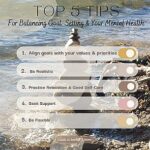
Top 5 Tips for Balancing Goal-Setting and Your Mental Health

It’s a new year! And, if you’re like many people, you might be reflecting on 2022 and setting new resolutions and goals for 2023. Interestingly, the practice of making resolutions dates back to ancient times, when people would make vows to the gods at the start of the new year to bring good fortune in the year ahead. Now, it’s become common practice to make promises to ourselves or set goals at the beginning of a new year to improve some aspect of our lives.

While this can be a great way to make positive changes in your life, it’s important to approach goal-setting in a way that is healthy and sustainable. This is especially true when it comes to our mental health, which can be deeply affected by the way we set and pursue our goals.

One of the keys to successful goal-setting is to make sure your goals are specific, measurable, achievable, relevant, and time-bound. This helps to ensure that your goals are clear and achievable, rather than vague or unrealistic. It can also be helpful to break larger goals down into smaller, more manageable steps. Focusing on one day at a time, one task, and one moment instead of looking at the whole year also helps to make achieving your goals more enjoyable and less overwhelming.

However, it’s important not to get so caught up in the pursuit of achieving the goals that you lose sight of the lessons in the process. It’s okay to make mistakes or have setbacks along the way. What we may preserve as a mistake or setback can be a valuable opportunity to learn and grow. It’s important to be kind to yourself and recognize that progress takes time. Remember to celebrate your successes, no matter how small they may seem, and take breaks when needed.

It’s also important to prioritize your mental health when setting goals. If you’re feeling overwhelmed or anxious, it may be helpful to take a step back and reassess your goals. It’s okay to adjust your goals, practice relaxation, and perhaps speak with a therapist. It’s important to remember that self-care is a crucial part of achieving your goals and maintaining good mental health.

There are many different ways to prioritize your mental health when setting goals. Some strategies include:

  • Setting goals that align with your values and priorities
  • Being realistic about what you can achieve and how much time it will take
  • Setting aside time for relaxation and self-care
  • Seeking support from friends, family, or a therapist
  • Being flexible and willing to adjust your goals as needed

It’s no doubt that goal-setting can be a powerful tool for making positive changes in your life. Prioritizing your mental health is key to achieving your goals and living a fulfilling life. Remember to be kind to yourself, set specific and achievable goals, and prioritize self-care and relaxation. And if you need additional support from a mental health professional I’m here to help. Just give my office a call at 818-806-9170. With these strategies, you are well on your way to setting and achieving your goals while also taking care of your mental well-being. May you have a happy and healthy New Year!

5 Tips For Managing Stress During The Holidays

It’s the holiday season and traditionally this time of year is thought to be one of joy and celebration. However, for many people, it can also be a source of stress. Between shopping for gifts, attending parties, and dealing with family dynamics, it’s easy to feel overwhelmed. However, there are things you can do to manage your stress during the holidays and make this time of year more enjoyable.

One of the most important things you can do to manage stress during the holidays is to set realistic expectations for yourself. This means not trying to do too much in too little time and being okay with saying no to invitations or tasks that are not a priority. It’s also important to be mindful of your budget and not overspend. Debt and financial concerns are major contributors to holiday stress.

Another key to managing stress during the holidays is to make time for self-care. This can include activities like exercising, meditating, or simply taking a few minutes to relax and unwind. It’s also important to get enough sleep, eat healthily, and make sure you have enough downtime to recharge.

One way to reduce stress during the holidays is to delegate tasks and responsibilities. This can be as simple as asking a family member to help with cooking or assigning tasks to different people when hosting a holiday party. It’s okay to ask for help and share the workload, especially during a busy time of year.

It’s also important to practice good communication during the holidays. If you’re feeling overwhelmed or stressed out, don’t be afraid to talk about it with a friend or family member. They may be able to offer support or suggestions for ways to manage your stress.

If you’re feeling particularly overwhelmed, it may be helpful to seek the guidance of a mental health professional. As a psychotherapist, I help my clients develop healthy coping strategies and provide support during stressful times.

Another way to manage stress during the holidays is to make time for activities that bring you joy and relaxation. This could be spending time with loved ones, participating in your favorite hobbies, listening to music, or simply taking a walk in nature. It’s important to prioritize activities that help you feel grounded and calm.

Finally, it’s important to remember that it’s okay to take a break from the holiday hustle and bustle. It’s okay to say no to a party or event if you need to, and it’s okay to spend some time alone if that’s what you need. Say yes to you! Taking care of yourself is crucial to managing stress during the holidays.

So remember, managing stress during the holidays is all about setting realistic expectations.

  • Practice Self-care
  • Delegate Tasks
  • Communicate Effectively
  • Seek Support if Needed
  • Make Time for Activities that Bring Joy and Relaxation

If you’re feeling overwhelmed this holiday season, try these tips to help you experience less stress and more comfort and joy at this time of year.

The Best Way to Manage Election Anxiety? Control Your Controllables

Studies are showing that this year’s election is triggering a higher level of anxiety in more people than ever before. Many people are worried that our Democracy is at stake and they fear that our health, safety, and future are at risk. The barrage of negative campaign ads and conspiracy theories, in addition to increased isolation due to COVID-19 and continued racial violence and injustice, have all heighten the fears of many Americans. Besides worry and excessive fear, many people are also experiencing trouble sleeping, increased or decreased appetite, sadness, irritability, muscle tension, avoidance, trouble concentrating, and feeling on edge. These are all symptoms related to anxiety, depression, and acute stress. So how do you manage these symptoms? What do you do when faced with uncertainty? What do you do when you feel out of control? The best thing to do is to identify the things within your control and practice them to the best of your ability. Here are just a few:

Take Deep Mindful Breaths – Focusing on the breath and deeply inhaling and exhaling relaxes the body and mind. Relaxation plays an important role in helping to regulate our emotional responses. Start by taking a few slow deep breaths. Inhale deeply and hold for 2 counts then exhale fully. Inhale and allow your belly to extend like a balloon filling with air then exhale as if you are letting all the air out of the balloon. You can even say to yourself the healthy things you are inhaling (i.e. peace, joy, love…) and exhale things you are releasing (i.e. worry, fear, anger…). Incorporating gratitude with each breath is also a helpful tool.
• Exercise Your Right to Vote – Voting matters and the ability to vote is within your control. Many people fought, died, and bled for this right and it is one of the ways to let your voice be heard. Voting is a powerful tool for expressing your desires and asserting your feelings. Advocating for yourself and others can lead to a sense of empowerment that contributes to overall health and wellbeing.
• Take a Break from the News – There is nothing wrong with staying informed. However, news reports often capitalize on what will win the most attention to increase ratings. These reports are sometimes speculative and fixate on threats that can arouse our nervous system. In order to reduce anxiety, it’s important to separate facts from fiction and take control of what information you take in. It’s also important not to feast on a steady diet of news but to take breaks and maybe watch a comedy or just turn the TV and other devices off altogether.
• Manage Your Expectations – Our expectations play a big role in our emotional responses. It’s important to have realistic expectations and those that are not tied to a specific and uncontrollable outcome. For example, if you are expecting a clear winner on Election Day and that doesn’t happen, the tension of uncertainty is prolonged. However, if you don’t expect it you can engage in other calming activities and stay grounded in the present, taking each day as it comes.
• Practice Good Self-Care – Some people falsely think of self-care as a luxury when in actuality it is ESSENTIAL. If you do not take care of yourself, you burnout, your immune system is compromised and you are unable to function in a healthy way. There are simple ways to practice good self-care like taking breaks, getting adequate sleep, eating healthy foods, exercising, going for walks, talking with friends, or listening to nature sounds or your favorite music. It’s also important to speak kindly to yourself and show yourself compassion. Speak comforting words to yourself as you might to someone you care about. How you nourish yourself is self-care and it helps to have a plan that you implement regularly.

If you are having difficulty practicing healthy coping strategies and your symptoms persist and cause distress, please contact a health care professional to help get you on the path to peace and wellbeing.

How to Manage Your Fear

Everyday there seems to be new reports of confirmed cases of COVID-19. As of this writing there were 247 reported cases in California, according to the CA Department of public health. Of these cases, the LA Times is now reporting 54 of them are in LA County and that number seems to be rising. Although these numbers are still lower in comparison to other parts of the world, it has raised serious concerns in our community. The World Health Organization declared the COVID-19 outbreak a global pandemic.

In response to this outbreak, schools are transitioning to online instruction, events are being cancelled, and people are self-quarantining and working from home in an effort to stop the spread of this virus. The term “social distancing” is trending and panic shopping as well as stockpiling are triggering shortages of common items.

Like many of you, I’ve felt a bit concerned too. Just a few days ago I went to the store looking for hand sanitizer and there was none to be found. The cashier told me that one person came in earlier and bought the whole shelf. I also went to several stores looking for toilet paper only to be greeted by empty shelves with no certainty of when they would be restocked. News reports are showing people fighting over these basic supplies and stocking up on water. Anxiety is often contagious. Fearful messages can spread panic like an uncovered cough or sneeze. When faced with all this social contagion it can be challenging to manage anxiety when so much seems out of our control and others are panicking on a daily basis. However, taking action in the following ways can help you maximize what is within your control and help calm some of your fears.

#1 Get the facts – Resist getting caught up in rumors. There is a lot of misinformation circulating. It’s important to do your homework and make sure you are getting factual information through trusted sources and keeping this information in a healthy perspective. Holding on to what you know to be true, while also holding space for the unknown instead of speculating in fear, is key to maintaining a sense of balance and some peace. You may also want to talk to a trusted health professional to process your concerns. The Center for Disease Control offers up to date information on their website https://www.cdc.gov/ and so does the World Health Organization at https://www.who.int/

#2 Plan and prepare – Follow CDC recommendations by washing your hands frequently with soap and warm water for at least 20 seconds. Keep your hands and fingers away from your eyes, nose and mouth as much as possible. Wipe door knobs, telephones and frequently used items and surfaces with sanitizing wipes. Avoid large crowds when possible and don’t go out if it’s not necessary. Drink water to stay hydrated and get adequate rest. If you are experiencing discomfort or difficulty with breathing, or are experiencing flu like symptoms seek medical attention. And if stocking up on food and water for 2-4 weeks eases your mind, then go ahead and do it! Make a plan for school closures and childcare. Having a plan and feeling prepared can help alleviate stress.

#3 Practice relaxation – When you feel anxious and stressed, your brain floods your nervous system with hormones and chemicals all designed to help you respond to a threat. This leads to a flight or fight emotional response that can be very useful in keeping you safe from actual danger. However, when that emotional response is fueled by social contagion, a fear of uncertainty and horror stories that we tell ourselves, it can go into overdrive and override our cognitive brain functioning. That’s were relaxation comes in. Practicing relaxation helps regulate our emotional responses by calming the emotional brain and nervous system to help reduce emotional reactivity and activate our cognitive brain. There are several ways to practice relaxation. Here are a few:

           • Deep breathing – Start by taking a few slow deep breaths. Inhale deeply and hold for 2 counts then exhale fully. Inhale and allow your belly to extend like a balloon filling with air then exhale as if you are letting all the air out of the balloon. You can even say to yourself the healthy things you are inhaling (i.e. peace, joy, love…) and exhale things you are releasing (i.e. worry, fear, anger…).
          • Meditation – People have varying ideas about meditation, however, there are many different ways to meditate that are not at all tied to any particular religious practice. Simply spending some quiet time in mindful reflection and awareness of our breath, our bodies and emotional state has been scientifically proven to reduce stress, lower blood pressure and control your emotions. Try it for at least 10 minutes a day. There are several meditation apps available to help guide this practice (i.e. Calm, Headspace etc.).
          • Grounding – This strategy helps to detach from emotional pain and keep you centered and feeling safe. In some ways it can be similar to meditation. There are 3 types of grounding. 1) Physical 2) Mental and 3) Emotional. You can practice physical grounding by jumping up and down, exercising or running cool or warm water on your hands. You can practice mental grounding by counting backwards from 100 to 2 by even numbers (i.e. 100, 98, 96…), solving puzzles or spending a few minutes identifying colors you see around you or sounds you hear. Emotional grounding can be practiced by looking at pictures that bring you joy, thinking of things that make you smile, playing with a pet or child.
          • Self-Care – Some people falsely think of self-care as a luxury when in actuality it is ESSENTIAL. If you do not take care of yourself, you burnout, your immune system is compromised and you are unable to function in a healthy way. There are simple ways to practice good self-care like taking breaks, getting adequate sleep, eating healthy foods, exercising, going for a walks or listening to nature sounds or your favorite music. It’s also important to speak kindly to yourself and show yourself compassion. Speak comforting words to yourself like you might to someone you care about. How you nourish yourself is self-care and it helps to have a plan that you implement regularly.
          • Gratitude – It’s easy to take simple things for granted sometimes. Keeping a gratitude journal can help you keep track of things that are good and for which you are grateful. Even when things seem bad, there is always something to be grateful for and something good. Even though our thoughts often overlap, it is very difficult to hold 2 opposing thoughts with the same focus at the same time. Therefore, the more you focus on gratitude the less likely you are to hold panic. Practicing gratitude daily helps you relax and slows the brains reactivity down by redirecting it towards more beneficial and peaceful thoughts.

The truth is that panicked and impulsive reactions can often be more problematic than the threat itself. Practicing these tools that are all within our control can help us navigate these turbulent times with a greater sense of calm to aid in making wise decisions. No one knows with all certainty what will happen in the future. But what we do know for sure is the sky is still blue, the sun is in the sky, and the earth is on its axis. We know there are experts and healthcare providers working hard on solutions. We have the ability to make choices and choose to follow CDC recommendations. We can choose to reframe our thoughts and use this as an opportunity to spend more time with our kids who may be home from school, or check up on the elderly.

We have the power to seek and speak truth, take positive actions and choose love and hope over fear. May you maximize all that is still good as we persevere through this human journey together.

Wishing you Wellness and Peace Always,
Lisa Locke, LMFT

Facing Regrets

Lessons About Fear, Poor Communication and Missed Opportunities

Last night, my husband and I went to see the movie The Photograph. If you haven’t seen it yet, you might want to check it out before reading this post, but I will try to avoid major spoilers. Although I mistakenly went into this movie expecting more of a romantic comedy, I was not disappointed with the overall story and performances in this romantic drama. I not only greatly appreciated the representation of Black love on the big screen, but I also enjoyed the thematic elements used to illustrate this budding love story.

In the movie, Issa Rae’s character (Mae) receives a letter from her recently deceased mother and is processing her loss and the history of their complex mother-daughter relationship. As Mae struggles to understand her mother as a famous photographer and a woman she really didn’t know, she meets Michael, played by Lakeith Stanfield. Michael is getting over a recent break-up and is a reporter that happens to be investigating a story in Louisiana, which is Mae’s mother’s hometown. In his pursuit of information for his story, he interviews longtime resident, Isaac, played by Rob Morgan. Isaac reveals to Michael his own sense of regret and shows Michael the photograph of his lost love, Christiana (Mae’s mother), played by Chanté Adams. The intertwining of these two love stories is poignant and reveals heartfelt truths about the impact of fear, lack of communication and missed opportunities in romantic relationships.

As human beings we all experience fear at different times and to varying degrees. Fear is our body’s natural response to perceived danger. In relationships, the perceived threat of emotional pain that may come from rejection and loss of connection can be enough to disrupt and interfere with any chance of lasting love. In the film Isaac feared change, Christiana feared stagnation, Mae feared becoming her mother and not knowing how to love, and Michael feared making mistakes and not knowing what to say. The way we navigate our fears is directly tied to our sense of peace and wellbeing. Just as the characters in the film, we all make choices.  In doing so, it’s important that we wisely evaluate risks and benefits in light of what is true about who we are and who we are becoming. Fear is not all bad. It can provide valuable information for us. However, it is important to see it for what is and not allow ourselves to be solely ruled by it.

Poor communication is also the culprit of many mishaps and regrets. Sometimes what’s not said is just as problematic as what is said. This fact shows up many times throughout the movie. In an effort not to spoil the plot I won’t get into details. However, it’s safe to say that all the characters suffered from not practicing honest and clear communication. Reasons for this can also be tied to fear, insecurity and lack of awareness. The good news is communication skills can be learned and do not have to be the downfall of a relationship. Again, open and honest communication can provide information and an opportunity for us to make informed choices and experience growth and maturity.

Lamenting missed opportunities can be a source of great emotional pain. Michael ends up writing an article entitled Loss, and that is exactly the feeling that is often described in response to perceived missed opportunities. We grieve the loss of what we think might have been. We tell ourselves a story of greener grass on the other side and regret our choices and decisions. Beating ourselves up over the past is not helpful, but learning from it and moving on with wisdom is the best we can do. It’s important to recognize that no one is perfect. And on our human journey, we are all trying to do the best with the information, resources and set of experiences we have at the given time. This recognition not only helps reduce some of our fears and improve our communication with others, but it also allows for self-compassion and compassion toward others that results in a greater sense of peace and harmony in our relationships and our world.

If you are experiencing distress in your relationships and would like to speak with a therapist please call 818-806-9170 to schedule a free 10-minute phone consultation.

To purchase a copy of Lisa Locke’s book Blockbuster Love – Part1: Romance: Lessons from the Movies on How to Create Lasting Love, click here. If you would like to be on the waiting list for the upcoming book Blockbuster Love – Part2: Reality: Lessons from the Movies on How to Create Lasting Love, like the Blockbuster Love Facebook page or view my website at LisaLockeMFT.com

Solving Marital Conflict

5 STEPS to Resolving Marital Conflict

Conflict has a way of spiraling, and that spiral can continue to get worse until the damage can become irrevocable. The results of unresolved conflict can have negative effects on those around you, especially children. Marriages that work tend to practice positive conflict resolution skills – which moves things forward instead of pulling them back or causing the relationship to stagnate. Here are 5 STEPS to practice:

  • State the problem clearly – Don’t fight about fuzzy things, be specific about what the conflict is over. Muddying the water with lots of issues is not at all productive, and is only destructive.
  • Talk through possible solutions – Keeping the conflict solution based will ensure that you’re actually moving towards a resolution instead of just going around in circles. Each person should offer up possible solutions.
  • Exercise self-control – This can be challenging, especially when emotions are high. You will be tempted to pursue things that aren’t part of the current issue. And perhaps tempted to say things that aren’t helping but that feel good in the moment. For the sake of your relationship, take a time out if necessary and practice self control.
  • Pick a solution to try – Choose one solution to try. Anything, it doesn’t have to be perfect and it doesn’t have to absolutely please everyone. Just agreeing to decide on one course of action can help move you closure together and reduce some emotional stress.
  • See how it works – Be open to a solution actually working. Don’t stay trapped in the current situation through sabotage or by having a negative attitude. Even if it wasn’t your idea or the idea that you thought was best, give it a chance and if it doesn’t work, try something else.

Following these STEPS can be easy at times, but it can also be difficult. Sometimes an impartial third party with professional experience can help couples manage emotions and improve communication . If you are finding it challenging to manage conflicts, couples therapy can help. Don’t wait or let frustrations pile up. Learn the skills you need to help restore peace.

Before you get married, love, marriage

7 Things You Should Know Before You Get Married


We often put SO much focus on the wedding day that we rarely consider what’s coming later in the marriage itself. The marriage is what it’s about! So before you jump in, or get carried away with dresses and honeymoons, read over these 7 marriage essentials.

  • Marriage is risky business – It is often said that with great risk there is great reward. But sometimes, especially if you are not prepared, things can go sideways and upside down quickly. That’s just a fact. This doesn’t mean that you should be paralyzed by fear, but it does mean that you need to realize that there are no guarantees. And you might consider investing in pre-marital counseling to help identify and prepare for possible risks while strengthening your loving bond and commitment.
  • Marriage is work – Not only does it take work, but the union of two imperfect and evolving people is a work in progress. It doesn’t come easy. But it does not have to be burdensome. Like any great work of art, the work of marriage can be a creative and exciting transfer of energy that ignites growth and improves the quality of your life. You will have to put effort into it to make it happen, a whole lot more than you might imagine.
  • Marriage is not a fairy tale – There is no mythical happily ever after. Yes there can be great moments of happiness and a deep feeling of contentment, but the story does not end there. Unlike fairy tales, marriage is a continuous journey of ups and downs and everything in between.
  • Marriage is the joining of two individuals – Losing yourself is not a requirement for marriage. In fact it’s about valuing yourself enough to show up authentically in a loving and respectful way that fosters love, acceptance and growth. It’s about staying true to who you are while being part of something bigger than yourself.
  • Marriage involves more than just two people – There are the in-laws, the friends, the kids, the boss. All these relationships have an impact on you and will also have an impact in your married life. In marriage you get it all.
  • Marriage is an adventure – You’re creating as story together! One that will constantly be changing and evolving. It’s OK to make edits along the way. You may need to learn some new skills to fully embrace and enjoy this adventure of a lifetime.
  • Marriage can be very rewarding – There’s almost nothing better than sharing your life with someone. There’s a reason that so many people do it! Be ready for the good stuff, because if you are open, realistic, willing to work and to give of yourself, the rewards are immense!
Stress, Secondary Trauma, affect of violence in the news

“If it bleeds it leads” –but may also lead to Secondary Traumatic Stress for Individuals and Families


Daily reports of violent acts, including police and video footage of shootings and killings, have left many people feeling angry, afraid and worried. Many African Americans and those in other minority communities have vicariously identified with the victims in several of these tragedies. This personal identification has led to feelings of hopelessness, shock and fear. A great number of people from various ethnic and racial backgrounds have cried out for justice, positive change and peace. And others have spoken out on social media under #BlackLivesMatter. Some have responded with #AllLivesMatter or #BlueLivesMatter. In the midst of all the controversy, what is evident is the deeply personal and systemic emotional pain. Even though many of us may not be directly involved in these horrific events and are just hearing about them and/or watching and re-watching them on TV or other media, we are emotionally affected. And some people experience more severe emotions than others. These common distressful reactions to hearing about traumatic events and the effects of watching horrific acts can often lead to Secondary Traumatic Stress (STS).

What is Secondary Traumatic Stress? Secondary traumatic stress is the emotional distress that results when an individual hears about the firsthand trauma experiences of another. Its symptoms mimic those of post-traumatic stress disorder (PTSD). Accordingly, individuals affected by secondary stress may find themselves re-experiencing personal trauma or notice an increase in arousal and avoidance reactions related to the indirect trauma exposure. They may also experience changes in memory and perception; alterations in their sense of self-efficacy, a depletion of personal resources, and disruption in their perceptions of safety, trust, and independence. [1]
What are some of the symptoms? This is a partial list:
  • Anger
  • Hopelessness
  • Insomnia
  • Avoidance
  • Sadness
  • Irritability
  • Poor Concentration
  • Aggression
Who Suffers? Everyone is at risk. Anyone who reads, watches the news or overhears conversations is vulnerable to STS. Couples and families and whole communities can be adversely affected. However, children, adolescents, parents and those in helping professions may be at greater risk. Risk appears to be greater among women and among individuals who are highly empathetic by nature or have unresolved personal trauma.
What are some solutions?
  • Increase Awareness of STS
  • Exercise and Good Nutrition
  • Stay Connected-prioritize personal relationships
  • Make a Wellness Plan
  • Psychotherapy
  • Practice good self-care
  • Create and/or participate in an accountability buddy system
We are all in this together. Ask for help when needed. Take periodic breaks from media. Take time to meditate. Nourish your personal relationships, your body and mind. Make personal wellness a priority.
“Love yourself, accept yourself, forgive yourself, and be good to yourself, because without you the rest of us are without a source of many wonderful things.” ~Dr. Leo Buscaglia
[1] http://www.nctsn.org/resources/topics/secondary-traumatic-stress